Category Archives: The Man

Saint Helena The Man Writing

Anniversary of Napoleon Bonaparte’s Death

Longwood Reception Room Where Napoleon Died 

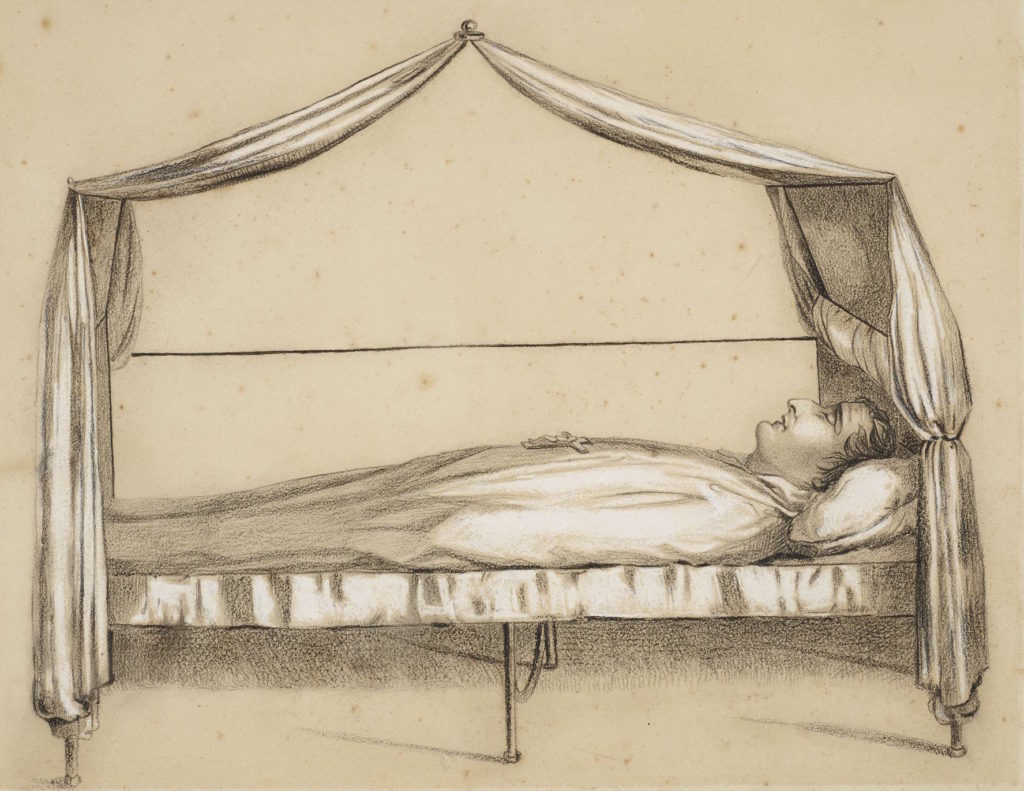
On May 5, 1821, Napoleon Bonaparte died in this room in exile on St Helena Island.

Two years ago, on May 5, 2011, I was in Cape Town, South Africa, on my way to St Helena to do research for my novel.

Margaret at Groot Constantia May 5, 2011 Toasting the EmperorTo commemorate the anniversary of the Emperor’s death, my husband and I visited Groot Constantia, the still-operational vineyard that supplied the Emperor’s wine during his exile. This evening we’ll drink a toast with some of his favorite Grand Constance wine that we brought back to the United States with us.

The Emperor has been dead for 192 years, yet he has been a constant companion to me as I write my novel from his point of view. So, today, a part of me mourns his death while another part of me says Come on. Really?

If you’re not a writer, if you don’t cry over sad books, if you’re not a Napoleon enthusiast, that may sound odd to you. Chalk it up to the wonders of human imagination.

Miscellany The Man

LOOKING FOR NAPOLEON IN AUSTIN, TEXAS

Finding Napoleon’s Friend Jean Lannes

Jean Lannes by François GérardWhile visiting family in Austin, Texas, this past weekend, I kept my eyes open for Napoleonic references. I discovered that the location itself, when chosen in 1838 to be the capital city of the Republic of Texas, had been named Waterloo. The next year the nascent republic’s congress rechristened it Austin, after the Texas hero, Stephen F. Austin. 

I haven’t determined exactly why the frontier outpost had been called Waterloo, but at least it explains why I ran across Waterloo Park, Waterloo Restaurant, Waterloo Pool Services, the music venue Waterloo Records, Waterloo Dialysis . . . well, you get the idea.  It became a tad depressing for someone writing a novel from Napoleon’s point of view. 

Happily, I discovered this magnificent larger-than-life portrait of Napoleon’s close friend Jean Lannes at the University of Texas’s Blanton Museum of Art. Having started life as a farmer’s son, the daring, capable general died a Marshal of the Empire and the first Duc de Montebello. He’s a fine example of the Emperor’s support for meritocracy. Napoleon is often quoted as saying that he found Lannes “a pygmy and left him a giant.” Today we lovers of meritocracy would be more likely to say that Napoleon created the opportunity for Lannes to transform himself into a giant. 

The Man

Happy Anniversary to Napoleon Bonaparte

Napoleon and Josephine Bonaparte’s Anniversary

Young Napoleon BonaparteJosephine de Beauharnais

On March 9, 1796, twenty-six-year-old Napoleon Bonaparte married the thirty-two-year-old widow, Josephine de Beauharnais. The groom, enraptured with his more nonchalant bride, is known to have written passionate love letters, including one containing the line, “I shall see you soon—do not wash.” Nevertheless, while poring over military maps on his wedding day, he lost track of time and showed up two hours late for the civil ceremony.

Perhaps that is why, on their wedding night, Josephine refused to expel her dog, Fortuné, from their bedroom. Years later, Napoleon recounted how the dog had bitten his ankle at a most inopportune moment.

One of the few witnesses at the wedding ceremony was Josephine’s business advisor, a man named Calmelet. Within earshot of the groom, he advised her not to marry the penniless young man who, in his opinion, would never amount to anything. Less than eight years later, in Nôtre Dame Cathedral, Calmelet witnessed Napoleon and Josephine being crowned Emperor and Empress of France.

Corsica Miscellany Saint Helena The Man

Napoleon on Camelback in the Musée Fesch

After seeing the photo of me riding an elephant, one of this blog’s readers asked if Napoleon had ridden a camel during his Egyptian Campaign (1798). Yes, Melanie! Here’s a photo I took of a small bronze statue of the Man himself on camelback. It’s displayed in the Musée Fesch in Ajaccio, Corsica, Napoleon’s hometown.

The Musée Fesch is named after Napoleon’s uncle, Cardinal Joseph Fesch, who was his mother’s half-brother. A great collector of art and artifacts, the wily Cardinal acquired considerable wealth during Napoleon’s reign.

After Napoleon’s fall, he retired to Rome with his sister, Madame Mère, as Letizia Bonaparte was known. There the two fell under the spell of an Austrian clairvoyant. The woman convinced them that angels had rescued Napoleon from exile in St Helena and were holding him in safety until time came for him to rise into power again. I’ve often wondered if the clairvoyant was an Austrian spy charged with keeping Napoleon’s mother and uncle from promoting plots for Napoleon’s escape from St Helena.

All of which proves (at least to me) that there is almost no end to the interesting stories about Napoleon and his family.

Miscellany The Man

Finding Napoleon in Southeast Asia

In November, 2012, I took a break from writing about Napoleon to travel in Southeast Asia, visiting Thailand, Cambodia, Laos and Vietnam.  It was primarily a bicycling trip, and, I assure you, my equipment was higher quality than what you see above in the photo snapped in the picturesque fields of Vietnam. Here’s another method of travel I definitely enjoyed.

During this trip, as always, I kept an eye out for references to Napoleon (or even Napoleon III, knowing that he had started France’s aggressive colonialism in SE Asia in the 1850’s).  I didn’t find much.

For example, downtown Hanoi still has some colonial French architecture, but at the famous Hotel Metropole, while the doorman says, “Bonjour” with a credible accent, that’s the extent of his French language skills.

Finally, after three weeks of travel, as I waited in the Hanoi airport for my flight home, I came across this image of Napoleon on a bag of coffee.  I think the best translation for the quote on the package is, “Without coffee, politics loses its soul.” I’d be happy to hear other suggestions.

The Man

Napoleon at the National Gallery in Washington, DC

This portrait of Napoleon, painted in 1812 before the Emperor’s departure on the disastrous Russian expedition, is one of my favorites. The Duke of Hamilton, who, as a Stuart, considered himself the rightful heir to the Scottish throne, commissioned Jacques-Louis David to paint it. It hangs now in the National Gallery of Art in Washington, DC, where I visit it frequently.

Corsica Saint Helena The Man

Bonaparte or Buonaparte?

As far back as Corsican records go, Napoleon’s family signed their name “Bonaparte.” In 1759, Napoleon’s father, Carlo, in his quest to establish hereditary links to Tuscan nobility, changed to the Italian “Buonoparte” form. Ten years later, his second son, Napoleon, was born under that surname.

Because Carlo had succeeded in establishing the family’s noble rank, young Napoleon was accepted as an eligible student in the French king’s military school. Seventeen years later, on March 9, 1796, twenty-six-year-old Napoleon signed his name Buonaparte for the last time—on documents marrying him to Josephine Beauharnais. From that date forward he reverted to “Bonaparte,” which appeared more French. Some claim that’s when he made a final break with his Corsican roots.

In later years, British propaganda used the foreign sounding “Buonaparte” to undermine his legitimacy as a French ruler.  That’s why the Englishman in this 1803 cartoon is gobbling “Buonaparté pie.” On St Helena, when the British refused to acknowledge the defeated Emperor’s imperial rights, they insisted everyone call him “General Buonaparte.”

Today, we see this same trick used in our own country when those who wish to diminish Barack Obama—a strange enough sounding name in its own right—call him “Barack Hussein Obama.” It’s in our genes to fear “the other,” but one can hope someday we’ll learn to rise above the instinct.

Corsica Sources The Man

Bonapartes banished from Corsica and France

As I wrote in an earlier post, the Corsican assembly, in 1793, voted unanimously “to inflict on the individuals making up [the family] Bonaparte an eternal brand that renders their name and their memory detestable to [all Corsican] patriots.” Six years later, however, during a stopover on Napoleon’s return from the Egyptian campaign, the Corsicans welcomed him as a hero.

France, too, banned the Bonaparte clan. In 1815, following the defeat at Waterloo and Napoleon’s second abdication, the French assembly, in support of the restored Bourbon King Louis XVIII, issued the following order:

“The ancestors and descendants of Napoleon Buonaparte, his uncles and aunts, nephews and nieces, brothers, their wives and children, his sisters and their husbands are excluded from the Kingdom in perpetuity, and are directed to leave it within a month, under pain of the penalty detailed in article 91 of the Penal Code [which included death].”*

When the French ban went into effect, Napoleon was a captive of the British, his brother Joseph was on his way to America, and his son was in  Austrian hands. Madame Mère and her brother Cardinal Fesch were en route to Rome. The rest of the family scattered across Europe.

But this “perpetual” ban, like Corsica’s “eternal” one, was short-lived.  In fact, its proposer, the Comte de Corbière lived to see Napoleon’s nephew crowned as Emperor Napoleon III in 1852.

* Quoted from Madame Mère Napoleon’s Mother, by Gilbert Martineau, John Murray Publishers, London, 1978

Corsica The Man

Happy Birthday, Emperor Napoleon

On August 15, 1769, in Ajaccio, Corsica, the Archdeacon Lucien Buonaparte celebrated the festival of the Virgin Mary, the town’s patron saint.  Young Letizia Buonaparte, interrupting her devotions, hurried home to give birth to her second son. The boy was named Napoleon after an uncle who had died several months earlier while fighting in vain for Corsica’s independence from the French. Only thirty years later, the French nation itself was happily in thrall to Corsican-born Napoleon.

For my own recent birthday, my brother gave me a bottle of Napoleon’s favorite Chambertin wine. I also received several tongue-in-cheek Napoleonic gifts: hard candy stamped with his image, a jigsaw puzzle of his coronation painting, a hoodie printed with David’s famous Crossing of the Alps painting, and, most amusing of all, a Napoleon bobble head.

Few other figures from two hundred years ago are so recognizable today. Napoleon might not approve of the bobble head, but I think he’d be pleased to be remembered.

The Man

200th Anniversary of the Russian Campaign

In June 1812, Emperor Napoleon marched from Paris with one of the greatest armies ever raised.  By the end of the year, what started out as 600,000 troops had dwindled to the mere 25,000 who made it home alive. One can blame disease, a severe winter, and the Russian scorched earth policy for hundreds of thousands of deaths, but in the end, it’s difficult for Napoleon enthusiasts to make credible excuses for this tragic expedition.

The struggle to understand the disaster gave rise to a famous chart, devised in 1869 by the French civil engineer Charles Minard. The narrowing band of tan depicts the diminishing number of men in the French force during the march to Moscow; the thinning black line denotes those who made their way back. Although recent scholarship has updated some figures, in principle the visual is horrifyingly correct.

For a personal insight on the campaign, I recommend Jacob Walter’s Diary of a Napoleonic Foot Soldier. This two-hundred page volume, which includes current commentary, comes from of the diary of Jacob Walter, a German infantryman conscripted into the Grand Army.  In it, Walter provides a vivid yet unvarnished description of the common soldiers’ fight for survival.  The text is available in print or as an excellent audio edition.

Copyright © 2011, 2012 Margaret Rodenberg