Category Archives: Saint Helena

Bonapartes Branded Corsican Outcasts

In exile on St Helena, Napoleon regretted not enriching Corsica when, as French emperor, he easily could have. Having developed an idyllic memory of his youth, he dictated to his secretary Las Cases that, “the Bonaparte family had retired [from Corsica] to Nice [in mainland France].”

Napoleon’s last visit to Corsica was a quick stopover in 1799 on the way back from Egypt. Soon to be First Consul, he was already the war hero of Toulon and the Italian Campaign. The Corsicans feted him as a famous returning son, but that wasn’t how he had left six years before.

On graduation from French military school in 1785, sixteen-year-old Napoleon received his commission as a second lieutenant. He spent the next eight years shuttling between stints in the army and long leaves in Corsica. This period, encompassing the turbulent years of the French Revolution, was an equally unsettled time in Corsica. Local factions vied for power and argued for either independence, integration in the French republic, or alliance with Britain. After a struggle that makes today’s partisanship seem tame, Napoleon and his brother Joseph were rejected politically and personally.

In May, 1793, the Corsican assembly voted unanimously “to inflict on the individuals making up [the family] Bonaparte an eternal brand that renders their name and their memory detestable to [all Corsican] patriots.” Napoleon went underground, hiding out for a time at the 16th century Tour de la Parata until his own faction rescued him. He in turn rescued the rest of the family.

On St Helena, Napoleon recalled that the British had ransacked the family home in Ajaccio. In reality, it was his fellow Corsicans.

Coincidence and the Man of Destiny

“Destiny urges me to a goal of which I am ignorant. Until that goal is attained I am invulnerable, unassailable.  When Destiny has accomplished her purpose in me, a fly may suffice to destroy me.”  Napoleon Bonaparte (from Napoleon: In His Own Words, 1916, edited by Jules Bertaut)

These words, attributed to Napoleon, reflect the belief he had in the power of an unknown force called Destiny.  Personally, I’m inclined to view Destiny, if anything, as a combination of genes, circumstance and free will.

Coincidence, too, plays a role. While I don’t think Destiny drives me to write this novel about Napoleon, here are a couple of fun coincidences:


The chair on the left is in the Briars, Napoleon’s first residence on St Helena.  The one on the right is in my library where I do most of my writing.  I inherited it from my mother who bought it at auction, then recreated the original needlepoint cover.

I took the photo on the left of the rug in Napoleon’s dining room in Longwood House on St Helena.  The photo on the right is a close-up of the similar Bokhara rug in my library at home.

I hope that my Destiny is not so tied to Napoleon’s that when I finish this book “a fly may suffice to destroy me!”

St Helena Slideshow

While I focused on writing my novel (working title: The Eaglet’s Legacy), October has flown by. As a final post before November, here’s a reminder to take a look at the video of photos from my trip to St Helena.

Napoleon’s St Helena Tomb

Before Napoleon died in 1821, the British government had instructed Governor Hudson Lowe that the emperor’s body was to stay on St Helena. A burial site was chosen about a mile from Longwood House on land owned by the merchant Richard Torbett. Initially, Torbett received £650 as an indemnity plus an annual subsidy of £50, but later, he negotiated a lump sum payment of £1200—not a bad deal as the emperor’s body was returned to France in 1840.

Thanks to information a descendent of Richard Torbett sent me, I learned that after the death of Richard Torbett’s widow, the house on the  property ended up in the hands of a freed slave named Sally Phil.  According to David Torbett, Richard’s great-great-great grandson, Miss Sally wrote the following poem:

Napoleon Death Masks

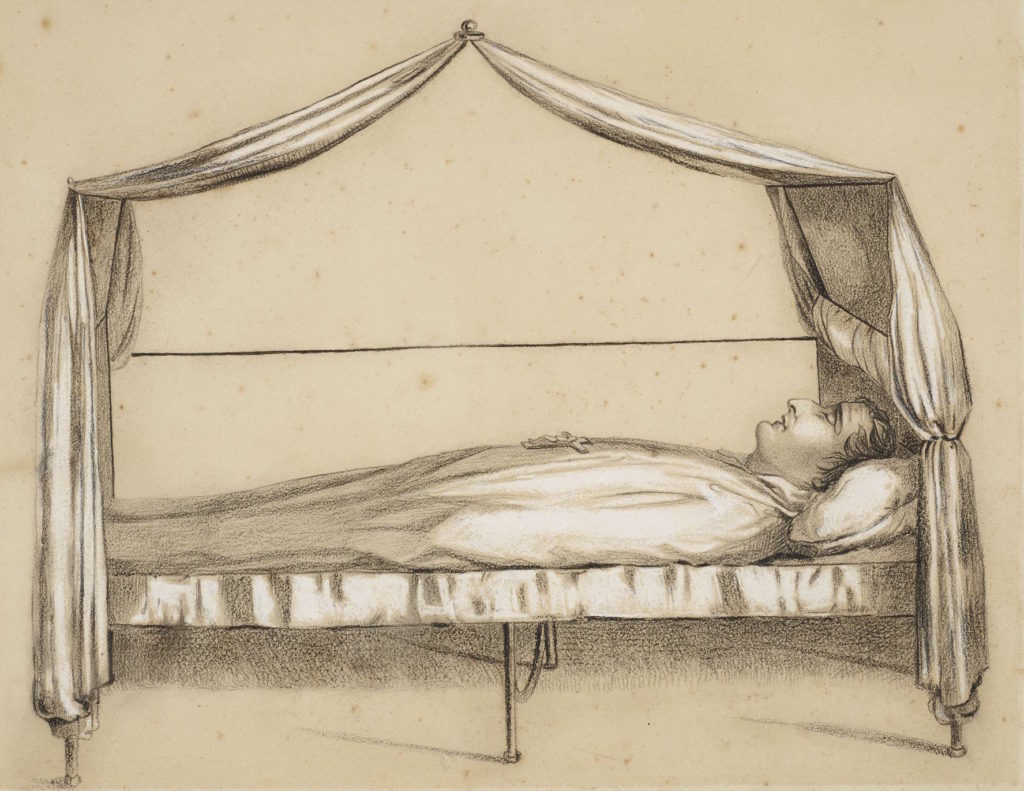
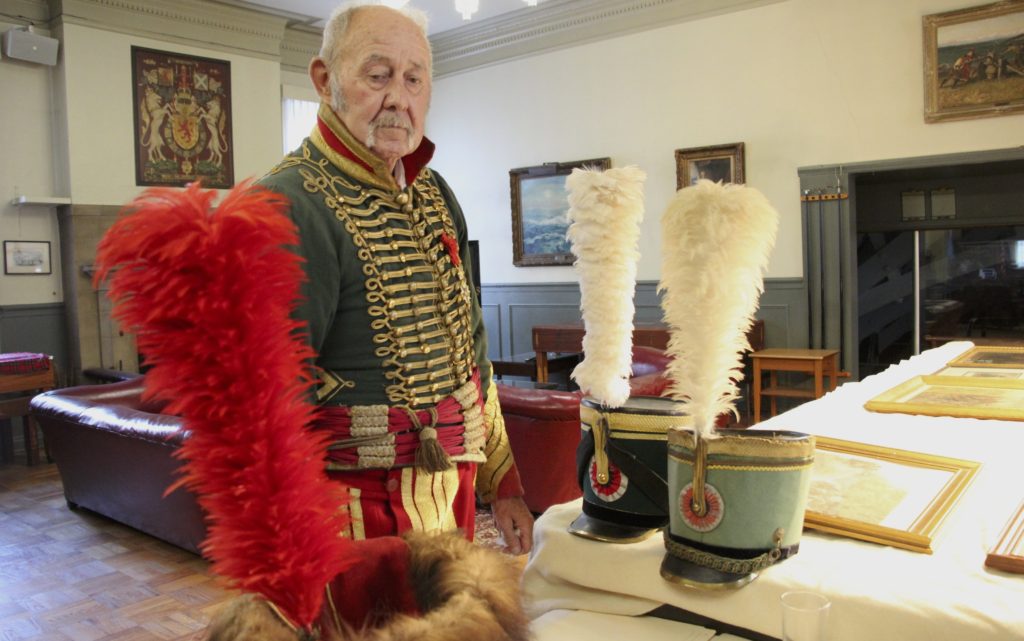
At the Napoleon birthday celebration at Fort Myer, Napoleon Historical Society member Vince Hawkins displayed his plaster death mask of the Emperor.  It’s been authenticated as one of only a hundred struck from the original that the attending doctor, Dr Antommarchi, created two days after Napoleon’s death in 1821.


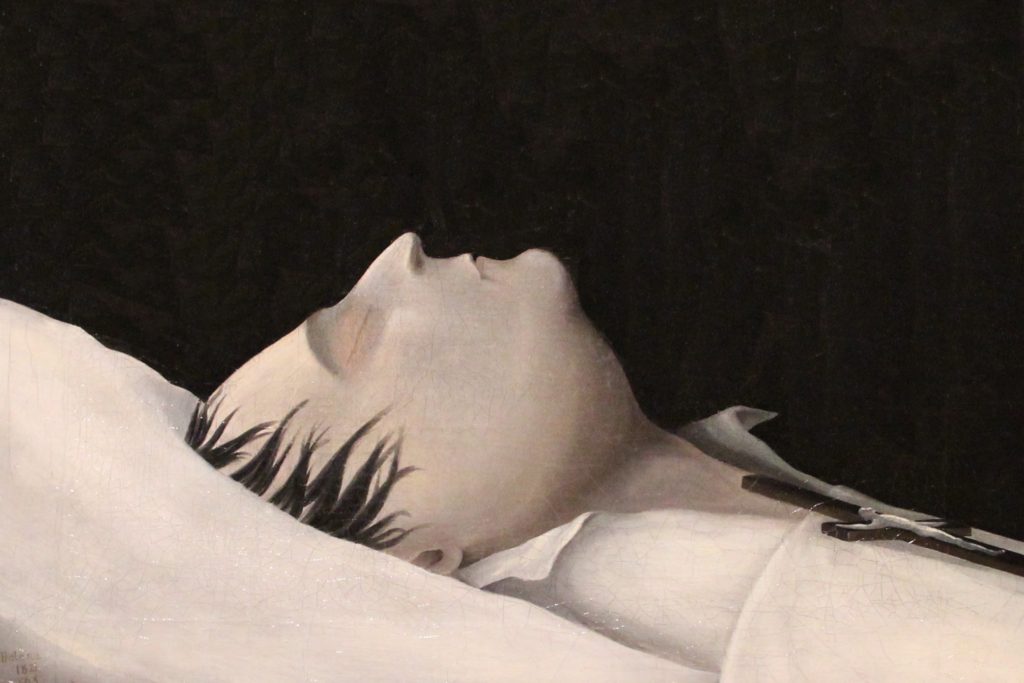
Napoleonic death masks appear in museums from Paris to Louisiana to Havana to Mexico City to Napoleon’s own death room on St Helena.  Some are bronze, some copper, others plaster.  Some are of questionable authenticity.  Above on the left is the mask from St Helena, and on the right, the one I saw at Fort Myer.  Last March, in Napoleon’s hometown of Ajaccio, Corsica, I saw five others.

There’s controversy whether Dr Antommarchi’s mask failed and a second one molded by a British doctor, Francis Burton, became the original.  Some sources claim General Bertrand’s wife, Fanny, stole Dr Burton’s mask and gave it to Antommarchi. However, as Napoleon’s valet Marchand reports in his well-trusted memoir, “Dr Burton had procured the necessary plaster.  Dr Antommarchi, helped by him and by Archambault [a coachman] who held up the Emperor’s head, made the mask in our presence.  It turned out well.” *

Although death masks seem macabre today, it was not unusual for famous people, in particular, to have one made.  That may be the only thing Lenin, Alfred Hitchcock, James Joyce, Beethoven, and John Dillinger have in common.

(*Excerpt from In Napoleon’s Shadow, Louis-Joseph Marchand’s memoirs produced by Proctor Jones.)

A BOOK REVIEW: To Befriend an Emperor, Betsy Balcombe’s Memoirs

A BOOK REVIEW:  To Befriend an Emperor: Betsy Balcombe’s Memoirs of Napoleon Bonaparte on St Helena, edits and introduction by J. David Markham, Ravenhall Books, 2005. (Originally published in 1844 as Recollections of the Emperor Napoleon on the Island of St Helena, by Lucia Elizabeth Balcombe Abell.)

As I covered in my last blog, Napoleon’s first home on St Helena was the one-room summer pavilion at the Briars, the Balcombe family estate. During his six-week stay, he developed an avuncular friendship with the Balcombe children, especially brash thirteen-year-old Betsy, who spoke French.

In 1844, Betsy published Recollections of the Emperor, a detailed account of their time together. In 2005, Ravenhall Press published a “gently modernized” version.  Historians still rely upon the memoir to document the emperor’s St Helena exile. To anyone interested in Napoleon, this light-hearted book provides fascinating insight into his character.

Napoleon loved children, perhaps because his own childhood had been cut short when, at age nine, he was sent to French military school.  During the following six years, he saw his father twice and his mother once.  The strict, almost monastic school left little opportunity for play.  As an adult, however, he loved rough-housing with his nephews, spoiling his toddler son, and teasing his generals’ children.

On St Helena, Betsy Balcombe became his favorite. According to the memoir, the emperor encouraged her pranks. Even when she held him at bay with his own sword, stole his official papers, or accused him of cheating at cards, he forgave her audacity.  Each tale, told in a precocious child’s voice with rich detail, gives the reader a humanizing portrait of a great man whose influence is still felt today.

Sometimes, the book turns to more serious subjects, as when Betsy quizzes Napoleon on the rumor about him becoming a Muslim in Egypt.  “[She asks] ‘Why did you turn Turk?’ He did not understand me, and I was obliged to explain that ‘turned Turk’ meant changing his religion.  He laughed and said, ‘What is that to you? Fighting is a soldier’s religion; I never changed that. The other is the affair of women and priests; as for me, I always adopt the religion of the country I am in.’”

When Napoleon left the Briars for Longwood House, Betsy and her family continued to visit him, but association with the Famous can lead to misfortune. British authorities accused Mr Balcombe of aiding Napoleon with unauthorized communications to Europe.  Stripped of his lucrative position as provisioner to Longwood, the Balcombes experienced an exile in reverse—banishment from remote St Helena.  Despite her family’s upheaval, Betsy saved the precious notes from her days with the emperor, supplying us a front-row seat to Napoleon’s St Helena exile.

The 192-page, hard-cover, 2005 edition, titled To Befriend an Emperor, features charming illustrations and updated spelling.  Noted scholar J. David Markham’s introduction provides excellent historical context.  Alternately, the original Recollections of an Emperor can be downloaded from Google Books for free.  I recommend either version of these sweetly-told stories as captivating summer reading with a Napoleonic twist.

(This review first appeared on the website, www.swanways.com.)

The Briars, Napoleon’s First St Helena Residence

In 1815, a few days before Napoleon Bonaparte arrived on St Helena, a fast sloop brought the governor news that the island had been chosen for the defeated emperor’s exile.  The surprised authorities scrambled to find a secure residence for their illustrious prisoner, but the remote South Atlantic island offered few choices. They settled on Longwood House, a set of run-down buildings on an arid plain, but it would take weeks to put the place in order.

When Napoleon disembarked, he and Admiral Cockburn, who had charge of his security, rode the five miles from Jamestown harbor to Longwood.  After six weeks in cramped ship quarters, General Bonaparte (as the British now insisted on calling the former emperor) had hoped for more comfortable surroundings.  Riding disheartenedly back to Jamestown, he and his escort came across a pleasant estate in a valley below a heart-shaped waterfall.  When they stopped to meet the owners, the Balcombe family offered the emperor their main house, the Briars, as a temporary residence.  Not wishing to inconvenience his hosts, he moved into their summer pavilion, a one-room building with an attic.

Napoleon stayed with the family for six weeks and often referred to that time as his happiest in exile. The Balcombes’ two daughters, who spoke French, quickly overcame their shyness.  The younger, a brash thirteen-year-old named Betsy, formed an immediate kinship with the man she’d been raised to think of as “a huge ogre  . . . with one large flaming eye.”

Although the Balcombe’s main house at the Briars was destroyed long ago, Napoleon’s summer pavilion has survived, with additions built on over the years.  The center room where Napoleon stayed is open to the public and contains memorabilia from his time there, including this oil painting of Betsy.  In my next post, I’ll review her memoir, Recollections of the Emperor on St Helena.

The Boy on the Mantel in Longwood’s Dining Room

In 1796, Napoleon married Josephine Beauharnais, the widow of an aristocrat who had been guillotined.  On their wedding day, Napoleon was twenty-six and Josephine thirty-two.  His future looked promising; she was bankrupt.  He married for love, she for convenience.  They had a tumultuous life together until 1809 when it became clear she could never provide him with a child.

Needing to shore up the future of his empire with a legitimate heir (preferably descended from established royalty), Napoleon reluctantly divorced Josephine and married Archduchess Marie Louise, the 18-year-old daughter of Emperor Francis I of Austria. On March 20, 1811, the new empress gave birth to their son, whom Napoleon designated the King of Rome.

Napoleon loved to play with his baby boy and showed more affection for the child than the royally-raised empress was able to express. Unfortunately, when France was invaded in 1814, Marie Louise fled with the King of Rome back to her father’s court in Austria.  Napoleon, although he lived for seven more years, was never allowed to communicate with either of them again.

I was surprised to learn recently that the popular British band, The Pet Shop Boys, had dedicated a song to the King of Rome on their 2009 album—one small example of the extraordinary influence Napoleon maintains to this day.


Longwood House Part 5

At the far end of Longwood’s reception hall, the room in which Napoleon died, a door opens into the dining room.

Here his companions-in-exile and his occasional guests gathered in the evening to eat a brief supper—for meals with Napoleon were only twenty-minute affairs. Afterward, they dissected battles or the emperor read aloud from Corneille, Rousseau, and even the Bible.

After his mother sent two priests to St Helena, the dining room was transformed into a chapel. At first, Napoleon attended Sunday mass inside the room; later, he watched from his adjoining study.  He said it was proper for him at his death to return to the Catholic Church since he had been born within it.  Years before, when questioned on his faith, he had replied that he “took on the religion of whatever country he was in, because that was the best policy.”

Of all the rooms in Longwood House, this one is the least personal for me.  Although the walls are covered in a facsimile of the former wallpaper, and the mirror with its horizontal crack is original, the many portraits and busts of Napoleon, his family, and his followers give it the air of a museum. I know Napoleon used to sit right there with his back to the fire, but I didn’t feel his presence within these four walls on any of my visits.

Perhaps, like me, Napoleon didn’t care for this room.  By 1819, he had taken to eating in his private chambers.


More St Helena Prisoners

In 1819, the French general and grand marshal, Henri-Gratien Bertrand, who had accompanied Napoleon into exile, designed a large birdcage for Longwood House’s gardens.  Chinese carpenters, who otherwise spent their time repairing the poorly-constructed house, built the cage and stocked it with doves and pheasants.

At first, Napoleon admired it, but he was known to free the birds, saying St Helena didn’t need any more prisoners.

Today’s cage at Longwood is an exact replica.  In 1840, nineteen years after Napoleon’s death, General Bertrand returned to St Helena as part of the honor guard accompanying the emperor’s body back to France. He also retrieved the birdcage.  That original is now in his family estate-turned-museum, the Musée-Hôtel Bertrand in Châteauroux, France.

Copyright © 2011, 2012 Margaret Rodenberg